
Layers of Time
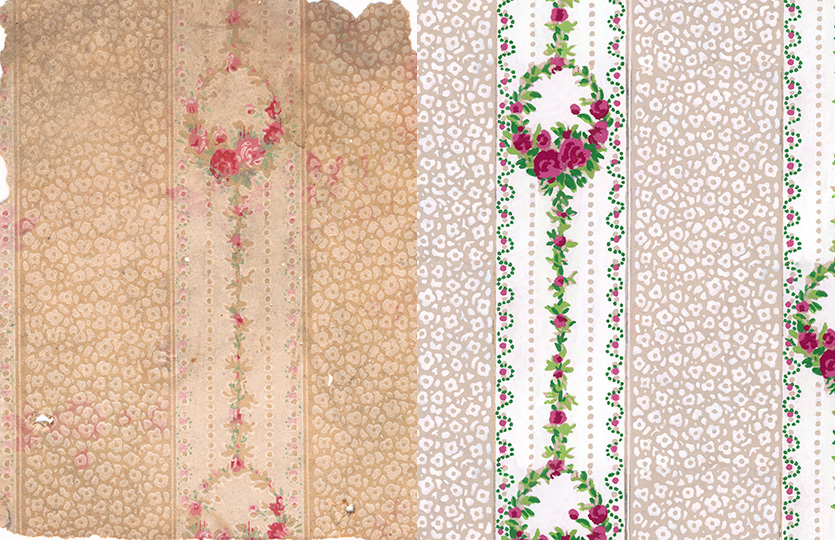
Use the slider to switch between them.
14 Henrietta Street is a social history museum located in the heart of Dublin.
Built in the 1740s, this imposing Georgian townhouse has witnessed the ups and downs of the many lives lived within its walls, as it gradually descended from grand aristocratic residence to cramped tenement.
Faint traces of some of these lives can be seen in the 14 Henrietta Street wallpaper collection. These faded, delicate paper fragments were carefully collected and conserved from the derelict walls during the restoration of the house in 2016. Dating from around the mid 20th century, they offer us a glimpse into the tastes, social aspirations and resilience of the 14 Henrietta Street tenants at that time.
Layers of Time is an online exhibition that tells the story of wallpaper from an elite, handcrafted, luxury item, to an affordable and industrially made product. From hand-painted panorama, to mass produced print, wallpaper is a historical document of cultural, technological, and social change.


About our wallpaper collection
Wallpaper Collection at 14 Henrietta Street
The growing affordability of wallpaper is vividly illustrated in the 14 Henrietta Street wallpaper collection. Most of these wallpapers were cheaply manufactured and date to the mid to late 1900s, well after the grand rooms of the house had been subdivided into tenements. Large families were often crammed into one or two of these sub-divisions, and many experienced poverty.
But even in these conditions, wallpaper remained an important way for residents to express personal tastes and feel a sense of domestic pride. It served both a practical and an emotional need, brightening dark rooms, covering decaying wall surfaces, and affording a sense of dignity in harsh conditions.
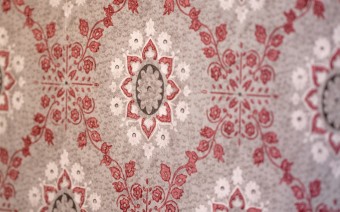
Remnants of these wallpapers can still be seen in Mrs. Dowling's, a recreated 1960s tenement flat in the museum. These wallpapers are modest in colour and design. If you look very closely at the pattern you can see that some were printed off-register, which indicates that they would have been purchased as ‘seconds’ - faulty goods sold at a reduced price.

Recreated wallpaper in Mrs Dowling's flat at 14 Henrietta Street.
Some of the papers are pasted to the wall with seemingly little concern for lining up and matching patterns, but this possibly reflects that the paperhanger was not in a position to throw away any off cuts.
Several of the older wallpapers from 14 Henrietta Street were printed with hundreds of tiny black dots included in the pattern. This was done to answer a problem that most people faced after they had finished hanging their new wallpaper - fly spot.
Flyspot is basically a not very delightful mix of fly poo and fly vomit. Flies would land on the pristine wallpaper and deposit tiny black dots. In the days before refrigeration, insulation and proper sanitation, flies swarmed in the warm summer months. Keeping them out of houses was extremely difficult, although net curtains could certainly help.
Wallpaper that had tiny black dots in the pattern went some way to concealing the little dots left by flies.
Wallpaper conservation
Irish artisan and historian David Skinner has played a key role in reviving traditional wallpaper printing techniques. Based in County Leitrim, he researches and hand-prints historic Irish designs. His work, including faithful recreations of 18th and 19th-century patterns, supplies restorations and brings Irish wallpaper heritage into contemporary relevance.
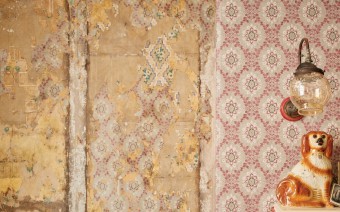
At 14 Henrietta Street, David recreated the 20th century wallpapers in Mrs. Dowling’s and in the ‘Playroom’ of the museum. In Mrs Dowling’s flat, a section of wallpaper had survived behind a bookcase, dating probably from the 1950’s. These and other faded, delicate paper fragments were carefully collected and conserved from the derelict walls during the restoration of the house in 2016. David’s recreation of this wallpaper allows visitors to the museum to see the original wallpaper itself, in its very worn condition, alongside the recreated wallpaper.

Traces of original wallpaper in ‘Mrs Dowling’s flat’ at 14 Henrietta Street, alongside recreated wallpaper by David Skinner
For the museum, it's really important to conserve and share these materials as part of our collection. These were everyday materials but have an important story to tell.
If you would like to learn more about the making of Mrs Dowling’s flat, you can watch this short film from our Making a Museum series. David Skinner appears at 1 minute 36 seconds.
History of Wallpaper
From China to Ireland
By the 17th century, there was a massive demand for elegant and exotic Chinese objects throughout Europe. This market was opened up to Europe by new maritime trade routes that were being developed and expanded by the Dutch and British East India Companies.
These new maritime routes superseded the ancient Silk Route, a mainly overland trade route that had existed from 200BCE to its decline around 1700CE. This ancient network of trade routes was 6,400km long.
It took a very long time for goods to reach Europe from China, as they were generally traded in relays across the Silk Route, rather than carried by a single supplier along the whole route. The new European shipping companies’ ships carried tea, silk, porcelain, furniture, and beautifully decorated wallpapers by sea to a huge and enthusiastic European market.
Many imported Chinese objects, including the beautiful Chinese wallpapers that became wildly popular in Europe from the late 1600s, were not actually used by the Chinese, but were specifically designed and made for export to Europe.
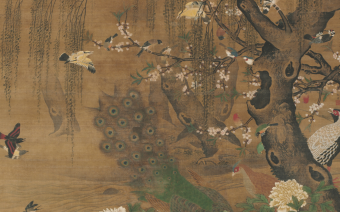
Painstakingly hand-painted on long panels of heavy linen, or mulberry paper, the wallpapers generally depicted Chinese landscapes, gardens, birds, and courtly Chinese people in domestic settings, without any repetition.
These imported Chinese wallpapers were the absolute height of fashion and were eye-wateringly expensive, well out of the financial reach of all but the wealthiest. They were prized possessions in aristocratic homes, often being mounted on battens, rather than pasted to the wall, so that they could be moved from one room, or one house, to another.
The Chinese Room at Westport House, County Mayo, and the Withdrawing Room in Butler Castle, Kilkenny, are 2 of at least thirteen rooms in Irish country houses that still feature their original Chinese wallpapers.
These exquisitely painted wallpaper panels were a big influence on ‘Chinoiserie’, a European artistic movement characterised by European interpretations of Asian objects, materials and motifs. Local makers from across Europe met the high demand for affordable Chinese style goods, ensuring that Chinoiserie continued its influence on art, fashion, furniture and clothing, well into the 19th century, and is still hugely popular today.

‘Birds Gather under the Spring Willow’ by the Ming dynasty imperial court painter Yin Hong
European and Irish Wallpaper: From hand made to mass-produced
Chinese, and later French wallpapers were highly regarded throughout Europe, but they were unaffordable to most people. European wallpaper industries sprang up to meet the demand. As early as 1670, Dublin's Guild of St. Luke listed "paper stainers" alongside other artisans, and by the mid-18th century, Irish craftsmen were producing hand-blocked and flocked wallpapers for a growingIrish market.
Up until the late 1700s, wallpaper was block-printed by hand, which was a slow and labour intensive method.
In 1785 the first machine for printing wallpaper was adapted from a recent invention of a mechanism for printing textiles, using rollers instead of blocks. This massively sped up the manufacture of wallpaper and also made it much cheaper to produce. Wallpaper quickly became widely available to all but the poorest members of society and continued to fall in price, and often in quality, throughout the following centuries.
The growing Irish middle class embraced wallpaper as a fashionable and accessible form of home improvement. Even the most modest households could now afford wallpaper to brighten their rooms.
Cities such as Cork, Limerick, Waterford, and Belfast had their own wallpaper makers. One notable figure, Caesar Fanning of Cork, advertised in 1773 that his wallpapers were "equal to any imported."
In Dublin, the Ormond Quay area became a hub of wallpaper production and sale. Retailers like Wigoders, founded in 1783, offered both imported and locally made designs and still trades today.
More recently, the Kildare Wallpaper Factory was built in 1936 on the outskirts of Kildare Town and was a major employer in the area. Some of the wallpapers in the 14 Henrietta Street wallpaper collection were made in this factory. It closed down in the early 1970s.
Poison Paper
In 1775 a new, brilliant green pigment called ‘Scheele’s Green’ was created from copper arsenite. Scheele’s Green became extremely popular and was used to colour wallpaper, among other decorative applications. It could also be mixed with other pigments to create rich purples, blues, yellows, greys, reds, mauves, and browns.
Scheele’s Green contained arsenic, and although it was well known that arsenic was a lethal poison when ingested, it wasn’t widely understood that its use in paints and dyes could also deliver a lethal dose of the poison. But in damp conditions, wallpapers could release arsenic gas. Arsenic could also flake off the wallpaper as tiny, airborne fibres and be inhaled.
There are many stories of people becoming very ill and even dying, with arsenic containing wallpaper being the common factor. In 1839 four children in London died of respiratory distress. Their bedroom had recently been covered with green wallpaper, tests showed that it contained a lethal quantity of arsenic.
While some medical professionals raised concerns, manufacturers such as William Morris initially dismissed them. But stories of death by wallpaper continued to make headlines and the public eventually became aware of the dangers of arsenic in wallpapers. Wallpaper manufacturers began to market their wallpapers as ‘arsenic free’. Mounting evidence and public pressure finally led to the removal of arsenic from most wallpapers by the late 1800s. With the introduction of aniline dyes in the 1860s, colours were produced that were just as brilliant and the use of arsenic based colours declined sharply.
As the use of the arsenic pigments ended so did the reports of wallpaper related health issues. Thankfully none of the papers in the Henrietta Street wallpaper collection are old enough to contain arsenic.

R. C. Kedzie (1874), Shadows from the Walls of Death
References and Credits
CREDITS
Exhibition research, and digital wallpaper reconstructions, by Suza Freeman, Conservation and Collections Manager at 14 Henrietta Street.
Physical wallpaper reconstructions in-situ at 14 Henrietta Street are by David Skinner.
Wallpaper fine art scanning by The Copper House, Dublin.
References
- Victoria and Albert Museum (n.d.) A Brief History of Wallpaper. (Accessed: 14 May 2025).
- Eschner, K. (2017) ‘Arsenic and Old Tastes Made Victorian Wallpaper Deadly’, Smithsonian Magazine (Accessed: 14 May 2025).
- China Daily – Shea, J. (2022) ‘China Wallpaper Graces Irish Home’, China Daily, 16 May.
- Skinner, G. (2021) ‘14 Henrietta Street: Inner City Heritage’, David Skinner Wallpapers – Journal, 11 March.
- V&A Museum (n.d.) Wallpaper Collection Overview.
- V&A Museum (n.d.) ‘Flock Wallpaper’.
- V&A Museum (n.d.) ‘Wallpaper: Health and Cleanliness’.
- SPAB Ireland (2021) Wallpaper in Irish Rural Buildings.
- Skinner, D. (2023) ‘Kildare Cottage’, David Skinner Wallpapers.
- San Francisco Airport Museum (2019) Zuber: The Art of French Scenic Wallpaper.
- British Museum (2024) British Museum Interpretation Guidelines.
Sources
- Deirdre McQuillan, Irish Times, on Dublin’s historic wallpaper trade and revival.
- David Skinner, Wallpaper in Ireland 1700–1900 (Churchill House Press, 2014) – book description.
- SPAB Ireland lecture notes, Wallpaper in Irish Rural Buildings (2021) – overview of Irish wallpaper from 18th c. to Kildare factory.
- Irish Examiner – K. deLongchamps, “Vintage view: The history of wallpaper” (2017).
- Westport House blog – “Restoration of the Chinese Wallpaper” (2021).
- The Irish Aesthete – R. O’Byrne, on French scenic wallpapers in Irish houses.
- J. Despard, “Notes on the Wallpaper Industry in 18th-Century Cork,” Journal of the Cork Hist. & Archaeol. Soc. 1947.
- Fota House Wallpaper Archive, Wallpaper History Society (2022).
- Wigoders (wallcoverings retailer) – company.
- Buildings of Ireland – Kildare Wallpapers Ltd. factory entry.
- Kilkenny Castle – Wallpaper Archive exhibition text (OPW, 2021).
- Victoria & Albert Museum – “A Brief History of Wallpaper”.
- Caesar Fanning of Cork, advertised in 1773